
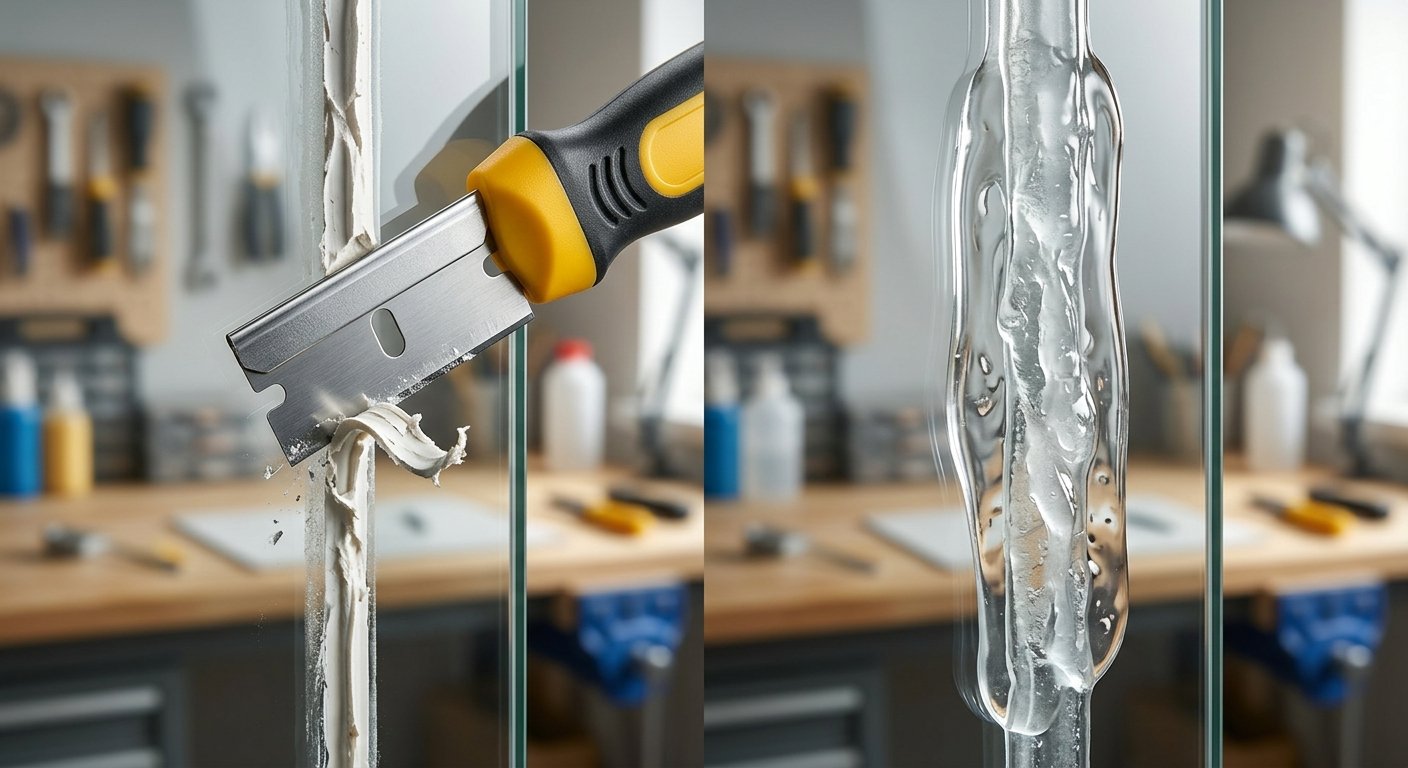
Stripping old silicone caulk off window glass, shower doors, or glass table tops usually leads to a classic DIY debate: razor blade vs chemical remover—which approach actually works better?
While a sharp blade promises immediate satisfaction by slicing through thick sealant, a wrong angle can leave permanent scratches across your glass. On the other hand, chemical removers break down stubborn polymers without touching the surface physically, but they demand long wait times and careful ventilation.
In this comprehensive head-to-head comparison, we evaluate both methods across speed, safety, scratch risk, and cost so you can choose the best strategy for your specific glass restoration project.
Method 1: Razor Blade Removal (Mechanical Scraping)
Mechanical scraping involves using a metal or plastic razor blade inserted into a safety holder to physically sever the silicone’s bond with the glass.
+------------------------------------------------------------------+
|                   RAZOR BLADE SCRAPING METHOD                    |
|                                                                  |
| [Step 1] Clean Dirt  -->  [Step 2] Angle Blade Low (15°-30°)     |
|                                       |                          |
| [Step 4] Wipe Residue <-- [Step 3] Slice Under Silicone Bead     |
+------------------------------------------------------------------+
Advantages
- Immediate Results: You don’t have to wait hours for chemicals to react. You can clear several feet of sealant in minutes.
- Zero Fumes: It is a 100% dry, chemical-free process—ideal for enclosed spaces like small bathrooms without windows.
- Low Cost: A pack of razor blades and a basic holder cost only a few dollars.
Disadvantages & Risks
- High Scratch Hazard: Using dull blades, rusted edges, or holding the razor at an angle steeper than 30 degrees can easily gouge glass surfaces.
- Ineffective on Microscopic Residue: Blades leave behind a thin, invisible silicone film that prevents new caulk from adhering properly.
[Internal Link: Anchor Text: “Best Tools for Removing Silicone from Glass” | URL:https://siliconeremove.com/best-tools-removing-silicone-glass/]
[Image Placeholder 1]
AI Image Prompt:
Macro photograph of a brand-new steel razor blade held in a heavy-duty yellow holder, slicing smoothly under a strip of clear silicone caulk on a clean glass sheet. Reflections on the glass surface, sharp focus, professional DIY quality, 8k resolution.
Method 2: Chemical Remover (Solvent Breakdown)
Chemical removers rely on specialized solvents (such as hydrocarbon-based formulas or organic digesters) to penetrate the cured silicone, causing it to swell, soften, and liquefy.
Advantages
- Zero Scratch Risk: Because no sharp metal contacts the glass, there is zero chance of scratching delicate, tempered, or tinted panes.
- Dissolves Micro-Film: Chemical agents liquefy the microscopic oily residue that mechanical scrapers leave behind.
- Easier on the Hands: Requires minimal physical effort—simply apply, wait, and wipe clean.
Disadvantages & Risks
- Long Dwell Times: Most effective chemical gels require anywhere from 30 minutes to 12 hours to fully digest cured silicone.
- Chemical Fumes & Mess: Solvents release volatile organic compounds (VOCs), requiring open windows, nitrile gloves, and sometimes mask protection.
[External Link: Anchor Text: “American Society for Testing and Materials (ASTM) glass surface standards” | URL:https://www.astm.org/]
[Image Placeholder 2]
AI Image Prompt:
A bottle of commercial caulk remover gel being applied to a stubborn line of old white silicone along the frame of a modern window pane. Clear gel clinging smoothly to the vertical glass, natural daytime window light, high detail, photorealistic.
Head-to-Head Comparison: Razor Blade vs Chemical Remover
| Feature | Razor Blade | Chemical Remover |
| Speed | Instant bulk removal | Requires 1–12 hours dwell time |
| Scratch Hazard | High (if technique is improper) | Zero risk to glass |
| Effort Level | High physical effort (scraping) | Low physical effort (wipe away) |
| Residue Removal | Leaves thin oily film behind | Completely liquefies film |
| Fume Risk | None | Low to Moderate (requires ventilation) |
| Best Surface Type | Uncoated, standard thick glass | Tempered, tinted, or delicate glass |
[Image Placeholder 3]
AI Image Prompt:
A hands-on action shot of a person using a yellow plastic scraper to wipe away liquefied, softened silicone residue after treating it with a chemical solvent, clean streak-free glass revealing underneath, bright workshop setting, photorealistic.
The Winner: Why a Hybrid Approach Works Best
When comparing razor blade vs chemical remover, the reality is that relying on just one method often leads to extra work. The fastest, safest way to strip silicone from glass is a hybrid approach:
- Slice the Bulk (Razor Blade): Use a sharp razor blade held at a flat 15 to 30-degree angle to cut away 90% of the thick silicone bead.
- Dissolve the Residue (Chemical Solvent): Apply a fast-acting citrus gel or isopropyl alcohol over the remaining haze to liquefy the lingering film.
- Final Wipe: Wipe the glass clean with a microfiber cloth for a pristine, streak-free surface.
Conclusion
When weighing a razor blade vs chemical remover, neither tool is entirely superior on its own. Blades excel at rapid bulk removal, while chemical solvents guarantee a residue-free, scratch-free surface. By combining both techniques—slicing the thick bead first and dissolving the remaining haze second—you achieve the fastest and safest finish possible on any glass surface.
Frequently Asked Questions (FAQs)
Will a metal razor blade always scratch glass?
No. Standard glass is harder than steel, so a clean razor blade held flat against the glass won’t scratch it. However, if the blade is nicked, rusted, or dug in at a steep angle, or if trapped grit gets dragged across the pane, it will leave scratches.
Can I use plastic razor blades instead of metal ones?
Yes! Plastic razor blades are made of high-density nylon and are completely safe for all glass types, including tempered shower doors and tinted windows. They won’t scratch glass, though they dull faster than metal blades.
What chemical dissolves silicone residue off glass completely?
Denatured alcohol, 99% isopropyl alcohol, and specialized citrus-based caulk removers (like Goo Gone Caulk Remover or McKanica) are excellent for breaking down remaining silicone oil films after mechanical scraping.