
Removing old silicone caulk from glass sounds simple until you are halfway through the job with a scratched window pane and sticky hands. Silicone is formulated to adhere tightly and withstand moisture, making mechanical or chemical intervention mandatory.
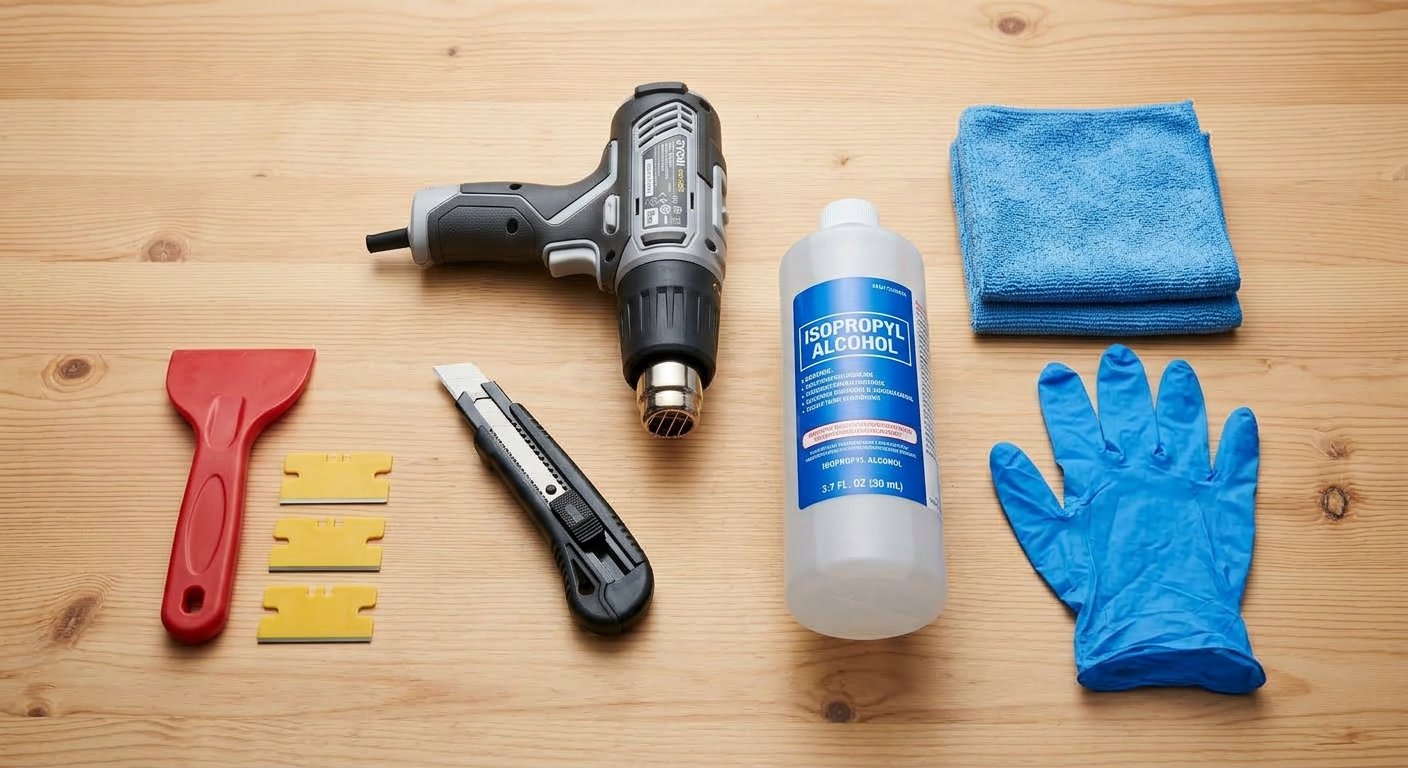
Having the right equipment on hand makes the difference between a frustrating chore and a fast, professional restoration. In this guide, we break down the best tools for removing silicone from glass across six essential categories so you can tackle shower doors, windows, and glass table tops with total confidence.
The 6 Essential Tools for Removing Silicone from Glass
+-----------------------------------------------------------------------+
|                    THE ULTIMATE REMOVAL TOOLKIT                       |
|                                                                       |
|  1. Plastic Scraper     --> Safely lifts thick beads without scratches |
|  2. Utility Knife       --> Scores precise edges along frames          |
|  3. Heat Gun            --> Softens hardened, brittle caulk           |
|  4. Silicone Gel        --> Digests remaining residue                 |
|  5. Precision Picks     --> Reaches tight hardware corners            |
|  6. Isopropyl + Rag     --> Strips oily film for a streak-free shine   |
+-----------------------------------------------------------------------+
1. Plastic Razor Blade or Scraper (Best Overall Safety Tool)
If there is one non-negotiable item in your toolkit, it is a pack of plastic razor blades. Made from high-density nylon or plastic, these blades provide the leverage needed to scrape under silicone without gouging glass.
- Why it works: Sharp enough to slice through sealant bonds, yet softer than glass.
- Best for: Tempered shower glass, coated window panes, and mirror surfaces.
2. Sharp Utility Knife
When dealing with thick caulk beads nestled in window tracks, a razor scraper alone might struggle. A utility knife allows you to score clean lines along both edges of the bead before lifting.
- Why it works: Slices the structural bond along frame joints so the caulk peels off in a single long strip.
- Best for: Windows, aquariums, and bathtub glass joints.
[Internal Link: Anchor Text: “Top 5 Silicone Removers Compared for Glass Surfaces” | URL:https://siliconeremove.com/top-5-silicone-removers-compared-glass-surfaces/]
3. Heat Gun or High-Wattage Hairdryer
Old silicone can become extremely brittle and stubborn over time. Applying gentle heat softens the flexible polymers, turning hard caulk into a pliable gel that slides off effortlessly.
- Why it works: Weakens thermal bonds without needing aggressive scraping force.
- Best for: Decades-old window seals and exterior glass panels.
[Internal Link: Anchor Text: “How to Use a Heat Gun to Remove Silicone from Glass” | URL:https://siliconeremove.com/how-to-use-a-heat-gun-to-remove-silicone-from-glass/]
4. Dedicated Silicone Remover Gel
When physical scraping leaves behind a stubborn footprint, chemical digesters do the heavy lifting. Solvent gels cling to vertical surfaces and break down the silicone matrix down to the bare glass.
- Why it works: Liquefies residue that blades miss.
- Best for: Vertical shower doors and large greenhouse panels.
5. Precision Picks and Cotton Swabs
Standard tools often cannot fit into tight corners near hinges, metal clips, or shower brackets. Dental picks, wooden sticks, or cotton swabs soaked in solvent help dig out residual caulk from small gaps.
- Why it works: Reaches tight geometries without scratching metal fixtures.
- Best for: Shower door hinges and detailed glass corner joints.
6. 99% Isopropyl Alcohol and Microfiber Towels
Once the bulk caulk is gone, silicone leaves behind an invisible oily haze that prevents new sealant from sticking. High-concentration isopropyl alcohol dissolves this film completely, while microfiber towels trap the oil without scratching the pane.
- Why it works: Leaves a pristine, residue-free surface ready for new caulk.
- Best for: Final glass prep and polishing.
Tool Selection Matrix
| Tool | Primary Purpose | Risk to Glass | Speed |
| Plastic Razor | Bulk scraping | Extremely Low | High |
| Utility Knife | Edge scoring | Moderate (if angled wrong) | Very High |
| Heat Gun | Thermal softening | Low (avoid concentrated heat) | Moderate |
| Remover Gel | Chemical digestion | Zero | Low (dwell time required) |
| Isopropyl Alcohol | Final residue prep | Zero | High |
Conclusion
Building an effective toolkit doesn’t require expensive machinery, but choosing the best tools for removing silicone from glass guarantees a smooth finish without costly surface damage. Start with a utility knife to score the edges, soft heat and plastic blades to lift the bulk, and finish off with isopropyl alcohol for a spotless, factory-clean result.
Frequently Asked Questions (FAQs)
Can I use a metal razor blade if I don’t have a plastic one?
Yes, but you must be extremely cautious. Keep the blade completely flat against the glass (at a 15- to 30-degree angle) and never use rusted or nicked blades, as they will scratch the glass.
Is a hairdryer hot enough to soften silicone?
In most household cases, yes. A high-wattage hairdryer on its highest heat setting can soften standard silicone enough for easy scraping, though a heat gun works faster on industrial-grade sealants.
Why is isopropyl alcohol better than glass cleaner for silicone residue?
Glass cleaners are designed to remove water-based dirt and dust, but they cannot dissolve silicone oils. 99% isopropyl alcohol breaks down the organic oil layer left by silicone, ensuring proper adhesion for your new sealant.